

이재석 Jaeseok Lee
Linkage, From Deconstruction and
Juxtaposition to Integration and Connection
Juweon Kim Curator
Artist
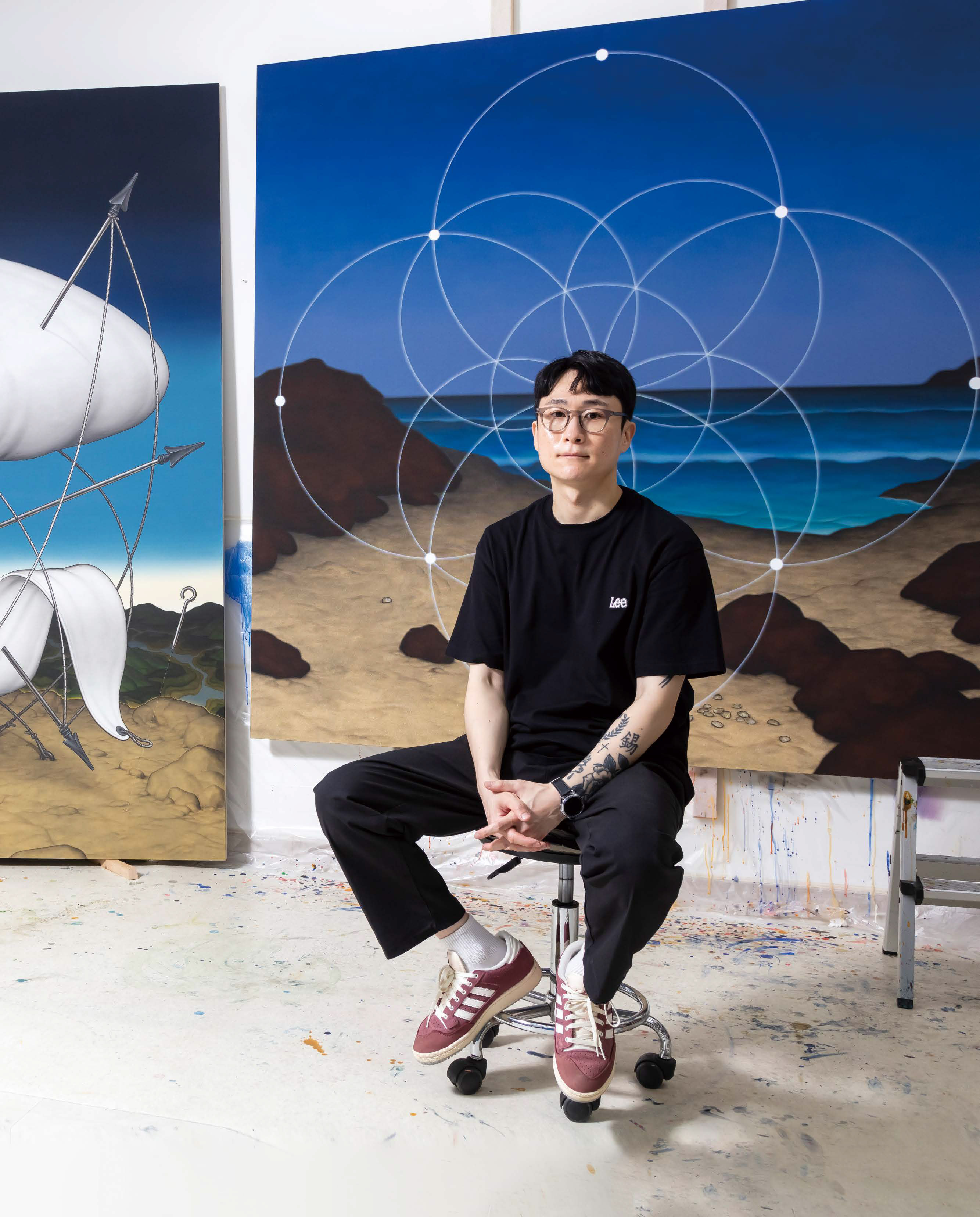
Lee Jaeseok/ b. 1989 Lee Jaeseok is an artist based in Daejeon. For several years, he has developed a body of work that explores the structural similarities between the human body and objects, drawing on his autobiographical experiences during military service. Lee received a BFA in Western Painting from Mokwon University and an MFA in Fine Art from the university’s graduate program. He has held solo exhibitions at Chapter II (2023) and SeMA Storage, Seoul Museum of Art (2021). His work has also been presented in curated group exhibitions at Gallery Baton (2023), Gwangju Museum of Art, Ha Jung-woong Museum of Art (2022), Seoul National University Museum of Art (2022), Space K (2020), and Daejeon Museum of Art (2019).
Linkage, From Deconstruction and Juxtaposition to Integration and Connection
Juweon Kim Curator
Whereas they once unfolded surrealist landscapes via the disassembly, deconstruction, and unfamiliar juxtaposition of anthropomorphized objects and mechanized bodies, Lee Jaeseok’s paintings have recently begun to demonstrate a marked shift, of which his recent piece entitled Linkage (○―○―●―○―○) (2024) provides a foremost example. Linkage (○―○―●―○―○), which depicts overlapping layers of mountains all over its canvas, breaks away from the fixed singular perspective that the artist formerly insisted upon and expands to a mapping where multiple locations and viewpoints coexist at the same time throughout the entirety of the painting. As a result, the canvas seems to take on the appearance of an abstract painting with mountains, valleys, and rivers presented through flat patterns and simplifications in a terrain without any sense of hierarchy.
Meanwhile, the foreground towards the bottom of the canvas is a departure from the rest of the painting in that it features the intricate depiction of a dry patch of soil and several blossoms sprung from a summer weed. In between the rich verdure of mountain valleys and streams glimpsed en masse in the distance, emphasis is placed on the arid and barren land from which no life form could possibly grow, and on the daisy fleabane flowering amidst ground without the least bit of moisture. The use of Lee’s signature trompe-l’œil technique likewise symbolically heightens the vitality of the blooming summer weed, causing the canvas to radiate an even more intriguing and surreal beauty.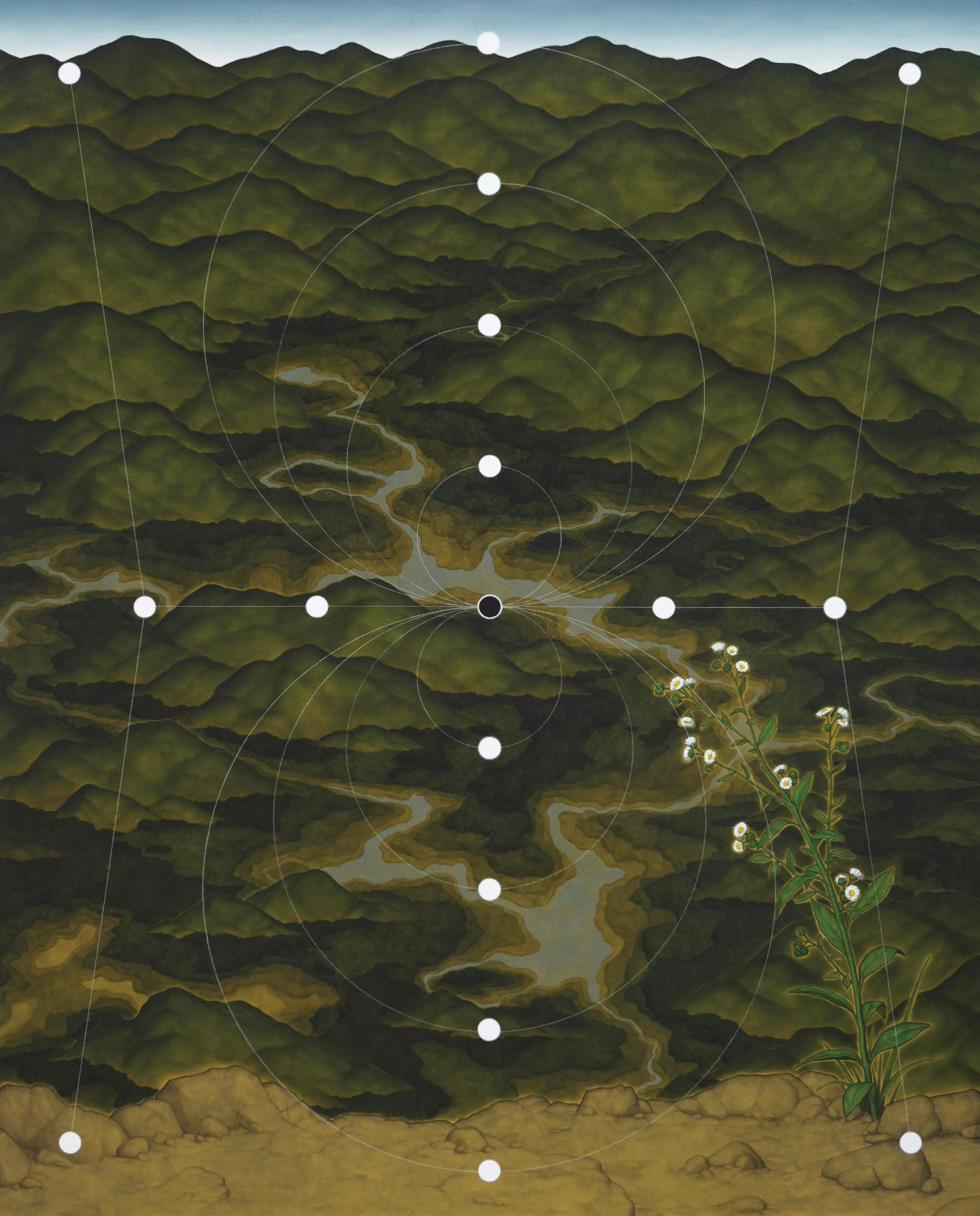
With its stark contrast between the infinite monotony of flat surfaces and the painstaking detail given to the solemn fortitude of the summer weeds, the space delineated within the canvas constitutes both an alternate reality/place conceived of and constructed by the artist and a metaphor for the world in which our struggles unfold as we live out our lives. Viewed in such a light, it resembles the other realities and virtual spaces/places perpetually available for us to encounter at the mere flick of a console switch. Visible and portrayable only to those on an airplane, this space and its flat contextualization through topographies such as Lee’s mountains, valleys, and rivers lend visibility to yet another reality and place, one that stretches out ad infinitum thanks to the linkage of symbol (○) to symbol (○) at regular intervals, a space that is commonly referred to as the World Wide Web.
Lee has disclosed that his background includes an extended period in middle school which he spent utterly absorbed in helping to develop a computer game program. Having received a chance offer from an indie game company, he came to take part in the work of formulating in-game backdrops and maps. The map production method used here has a great deal in common with map creation based on aerial photographs, as it involves placing texture tiles made out of dotting multiple points out on a virtual grid and generating a layer atop them before interspersing that layer with objects such as trees, grass, and rocks.
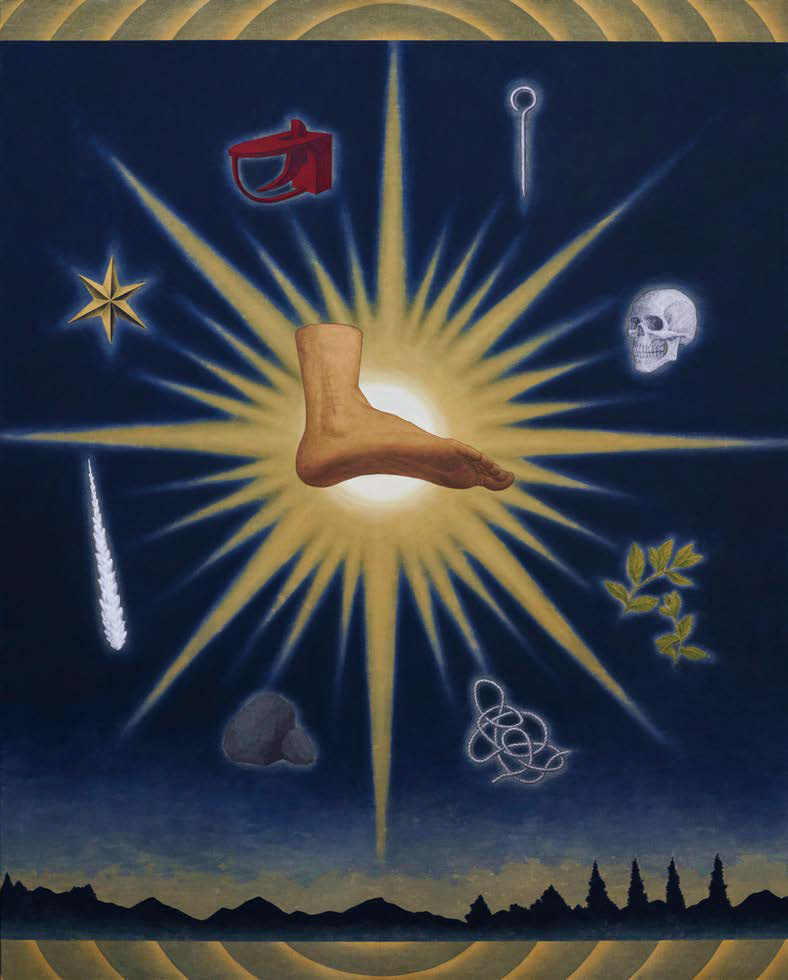
This provided the bedrock of Lee’s strategic intent “to blur the boundaries between the real and the virtual by displaying within the frame of the canvas virtual spaces seen from my perspective, as well as the images which interact (seem to operate) therein.” Here, Lee turns multiple or singular elements of nature or objects which exist as symbolic motifs on his canvases into coordinates as signs. The artist causes these signs to connect to one another through meaning or through (dotted) lines, while himself becoming a linker/linkage editor who formulates reality and the virtual realm, and this world and that world.
The gravity exerted by the symbol (●) as a central point takes on visual form through the repeated appearance of the symbol (○) that connects (―) the terrain in Lee’s canvases in all directions. Much like a spider’s web or the stars and constellations, the world, too, opens up and expands without limit or end. The virtual space of the game mapped and constructed via the omniscient linker’s perspective is both homogeneous with and heterogeneous to the real world. A visual radius otherwise banned from reality spreads outward in the virtual space of the game. These characteristics of in-game screen images can similarly apply to the canvases of Lee’s paintings.
Most of Lee’s paintings in this vein are ordered unforgivingly according to ‘regulatory lines’—that is, a grid which determines the backbone of the world in question or the arrangement of motifs within it.
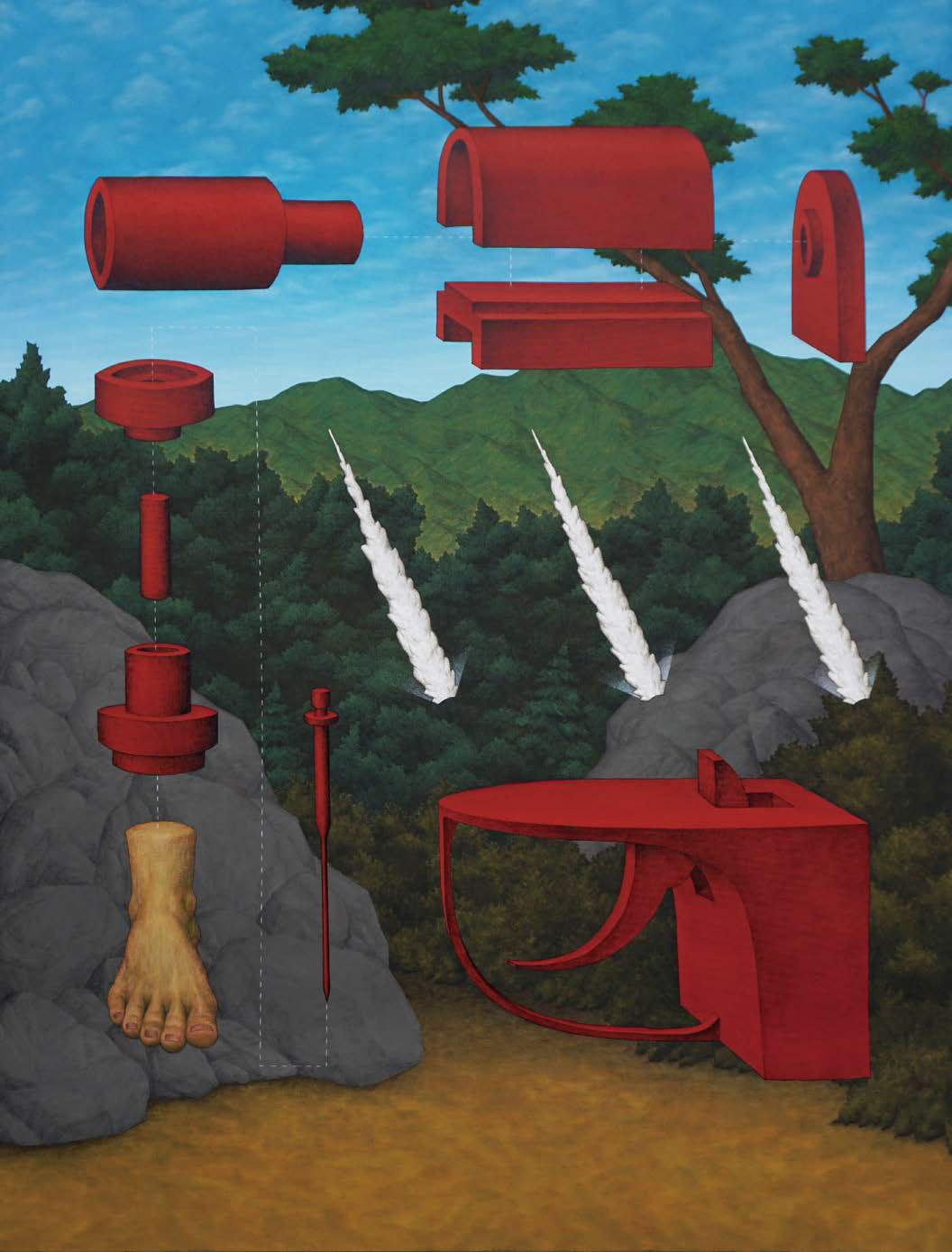
Fragment, Parts in Alignment, and Lumps of Flesh fill their respective canvases with pieces, disassembled human bodies, and machines/geometrical figures akin to the individual parts of a plastic model, while at the same time, they transform bodies into machines/geometrical figures and machines/geometrical figures into bodies. Work such as Range_3 (2021), Connected Islands (2022), Pine (2022), Night and Day (2022), and Constellation_2 (2023), on the other hand, features symbols such as numbers, letters, stars, and circles that commune with and connect to one another in place of the various modules that the artist previously disassembled, deconstructed, and regimented. In the case of the former group, two implications come embedded within the modular regularity seen in the horizontal arrangement of bodies and machines/geometrical figures encapsulated in the canvas of a square frame. The first of these is the establishment of a new relationship between the human body and objects; the second is the recognition of the paradoxes ingrained in the fascinating order of modern systems such as industrialization, the nation-state, and informatization.
Lee takes note of the fact that only the normal functioning of various internal organs bolsters a healthy physicality, just as the structural integrity of the smallest parts of a firearm strengthen its functionality. Firearms and human bodies, though completely disparate from each other on a fundamental level, turn into a singular world which maintains structural equivalence in accordance with the artist’s analogy. Therefore, the fragments of Parts in Alignment and Lumps of Flesh are disassembled, severed, and rearranged within the same hierarchy, while an accretion of red geometrical figures/tools stands in for the ‘self-portrait’ section of Studio View.
At the same time, Lee hones attention to the ‘individual’ or the ‘fragment’ behind the beguiling aspects brought to the surface by the systems of discipline, control, and management intended to reinforce the configuration of the ‘group’ or the ‘whole.’ The body parts of different shapes and sizes that mark his canvases are physical clumps which have been transformed and sculpted with reference to the artist’s own joints or distinctive parts of his body structure. Compliant to the square frame and grid net, these clumps are irregular pieces but they also have the slick-smooth skin to induce grotesque and hallucinatory scenes. The artist critiques the contradictions of the modern system which have long persisted despite the protests of many. He does so in a manner that is neutral rather than cynical; he does so as someone grappling with what is both a miserable reality and a beautiful and sublime fit of surrealism—an unrealistic fantasy.
Lee adopted techniques that are semantically similar to, or formally distinct from, those used by the Surrealists—drawing inspiration from methods such as collage, frottage (images created through rubbing), and grattage (images created through scraping)—thereby orienting himself toward pieces that are ‘exemplary paintings’ unlike the Surrealist work which strives for something ‘beyond painting.’ Primarily using oil and acrylic on canvas, Lee forges a deliberate collage of contradictory images within his pieces. He applies multiple layers of acrylic to the back of his canvases, stripping the original glossiness of the paint down to a bare minimum. Perhaps there is nothing new per se in this attempt which appears to be in close affinity with classical painting techniques. Nevertheless, the deliberate minimization of sheen in the acrylic secures a distinct and deep-ranging dimension of color that prompts the assimilation of contradictory spaces.
As of late, Lee has started to paint his work atop an uneven application of three to four coats of dense and undiluted white water-based paint, creating varying levels of thickness across the canvas. The surface of his paintings accordingly comes to adopt an uncalculated and irregular texture due to the repeated application of heavy base coats of paint, with the pieces themselves turning into spaces in which precarious and accidental perspectives subsist. We see here the virtue of Lee’s paintings, as he seems to argue for ‘exemplary paintings’ after having discovered in the digital images generated and circulated on the Web the possibility of restoring the traditional values of painting long since jettisoned by the clamorous and aggressive experiments of the avant-garde.
On the other hand, one of the defining characteristics of Lee’s work continues to lie in ‘the juxtaposition or conjunction of double realities with seemingly nothing in common.’ Evoking a verse from the early 20th century Surrealist poet Lautréamont which reads almost like a riddle when it says, “as beautiful as the chance encounter of a sewing machine and an umbrella on an operating table,” Lee’s beautiful paintings (in their beautiful depth) brim with undeniable surrealistic nuance.
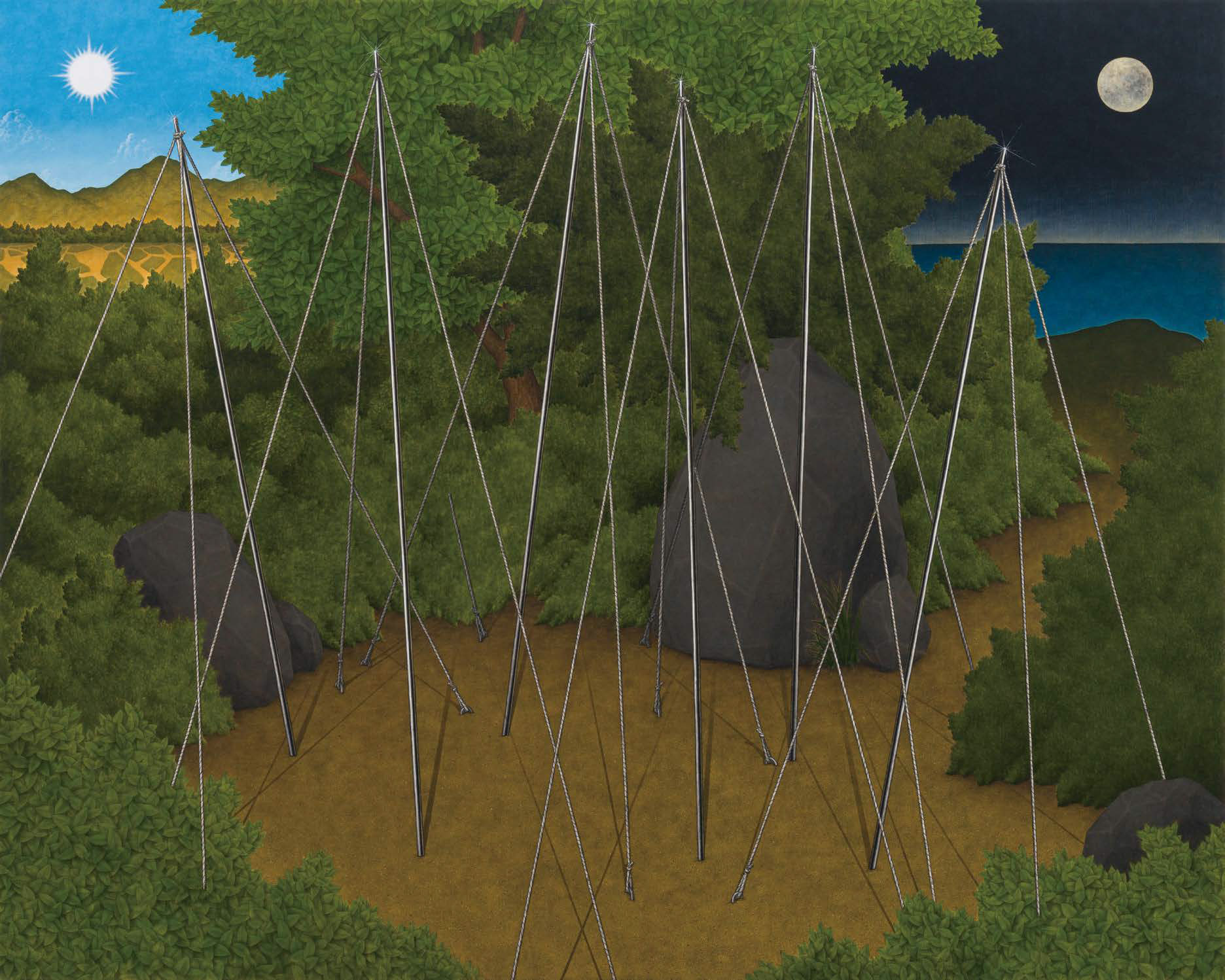
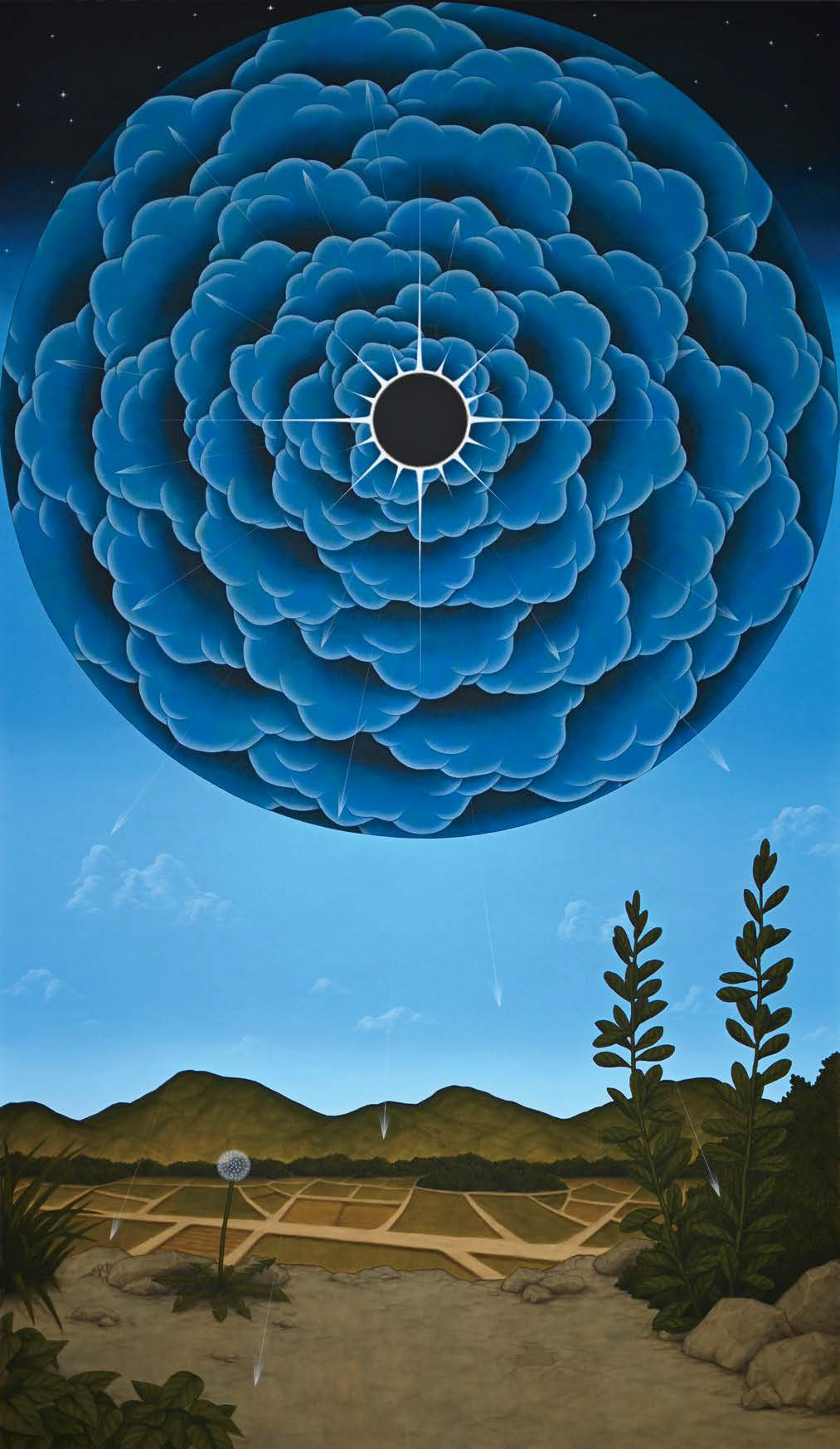
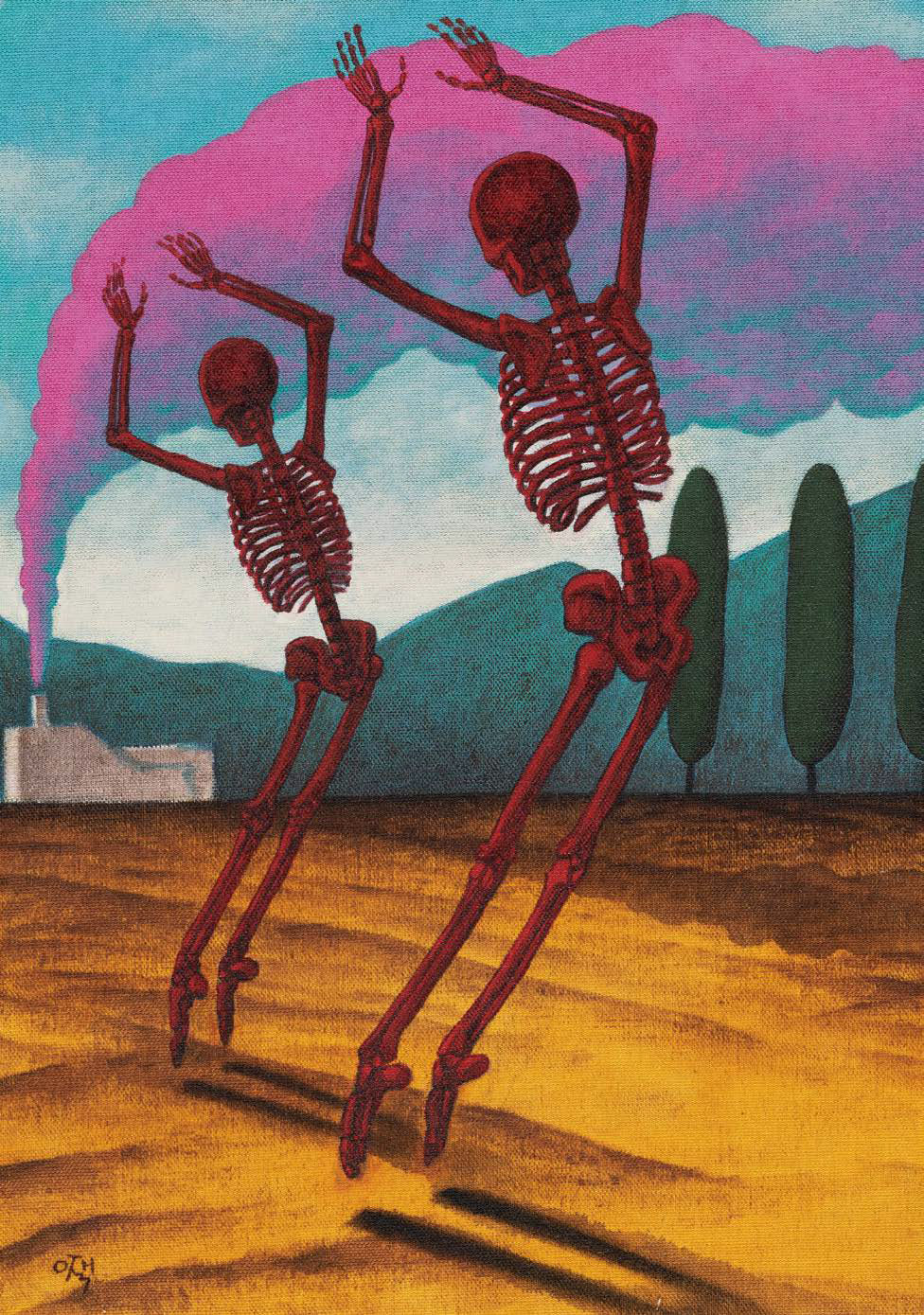
For example, while fragmented, componentized, and objectified chunks of flesh like plastic models and parts, tools, and objects with red blood flowing through them are placed alone or juxtaposed on one screen, skeletons that are both objects and bodies and bodies and objects, tools connected to severed bodies, shoes, wooden floors, white cloth, and geometrical shapes are arranged through formal and content-specific disconnection or connection and reconfiguration. With his recent canvases featuring symbols such as stars, black and white circles, white spheres bursting into light, and even moving bugs from within game play, Lee has once again set out to link anthropomorphized natural elements with various realities and methodologies.
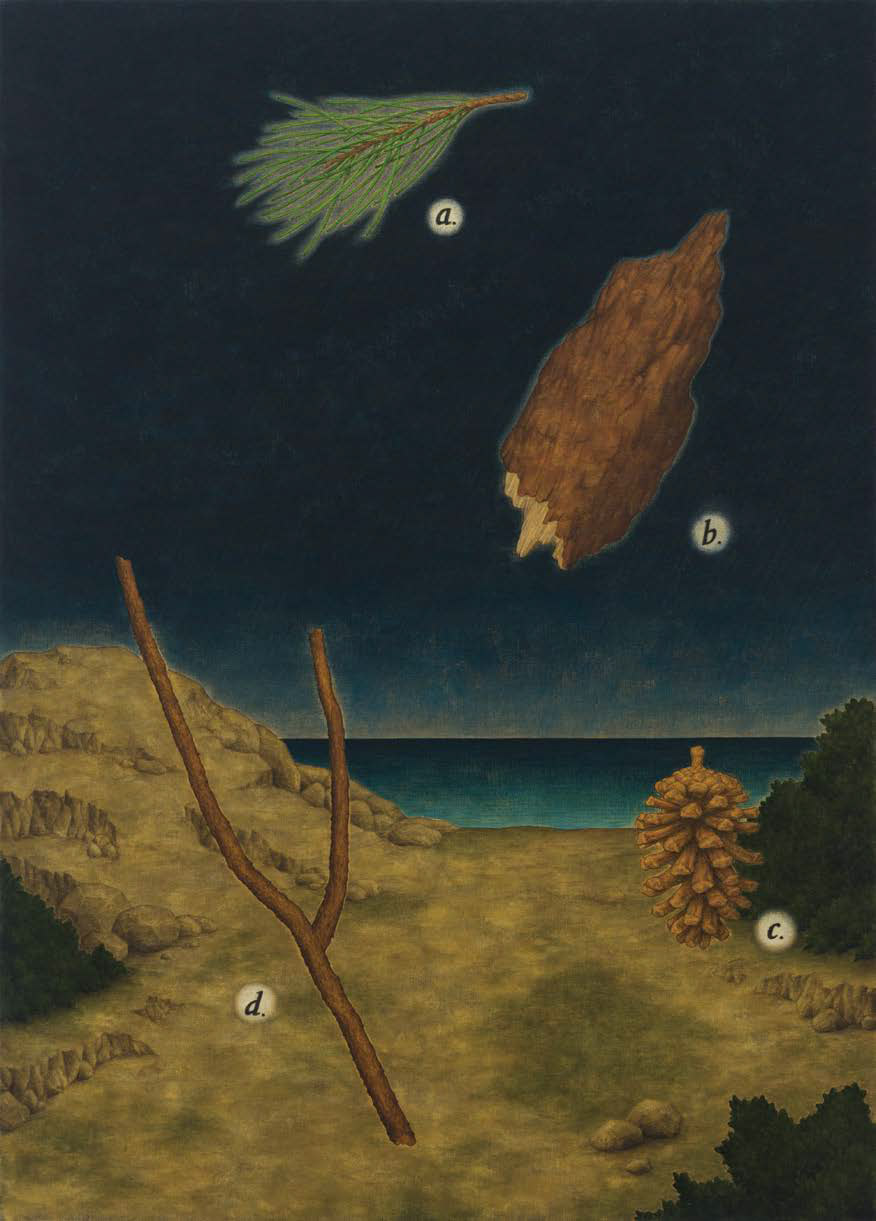
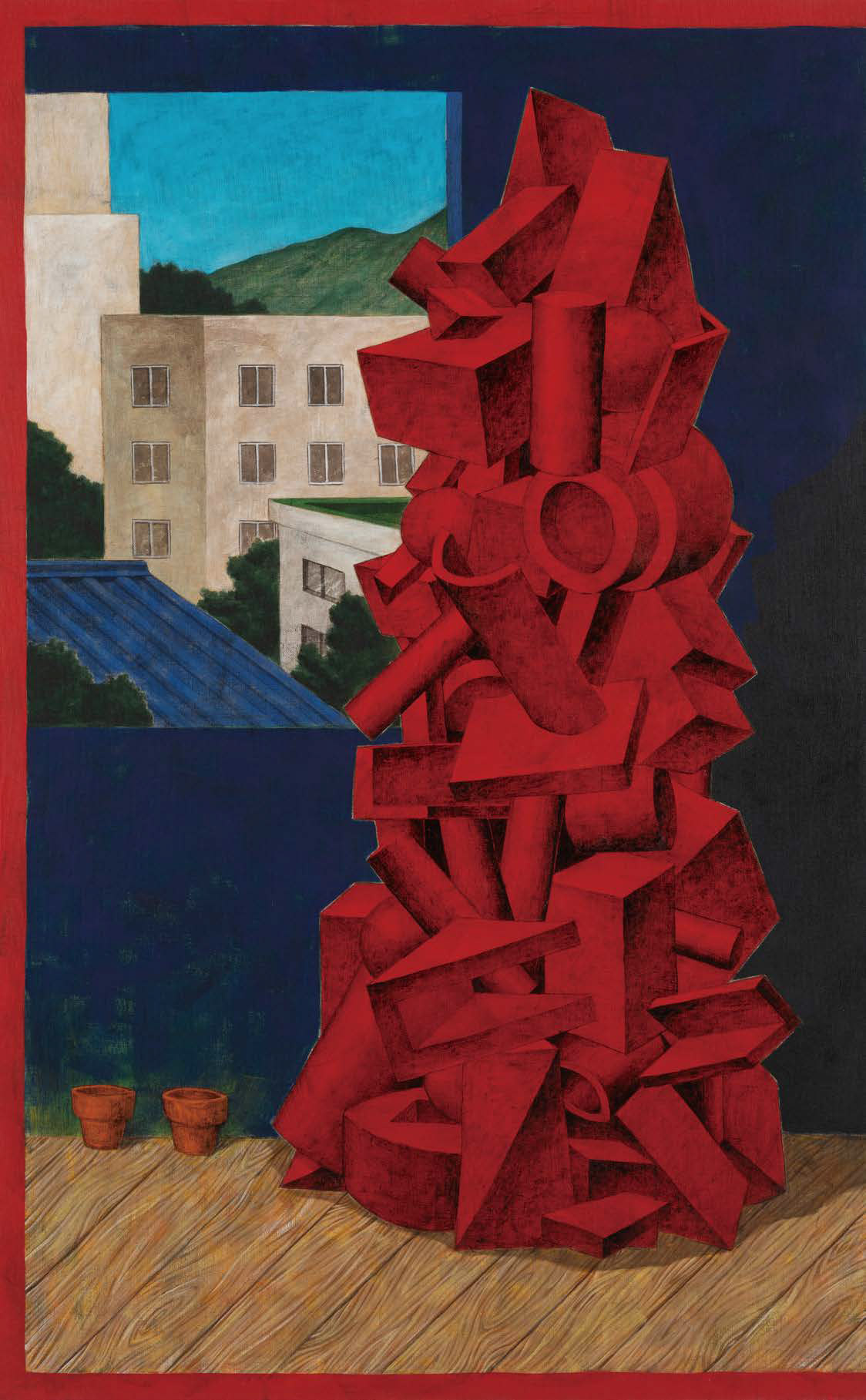
At first glance, these images seem to present two outwardly unrelated realities. More specifically, dichotomies such as object vs. body, tool/geometrical shape vs. flesh/blood, stone/forest (nature) vs. skull/mannequin (body/object), nature vs. symbol, star vs. bear, sun vs. moon, and so forth constitute separate realities and existences at odds with one another. Nonetheless, they have been positioned within their respective canvases according to a classical yet somehow precarious linear perspective and by the forces of gravity. Lee’s unsettling juxtaposition of unfamiliar and provocative images, along with his irrational narrative structures, had their full-fledged beginnings due to a series of events and experiences which took place during his military service.
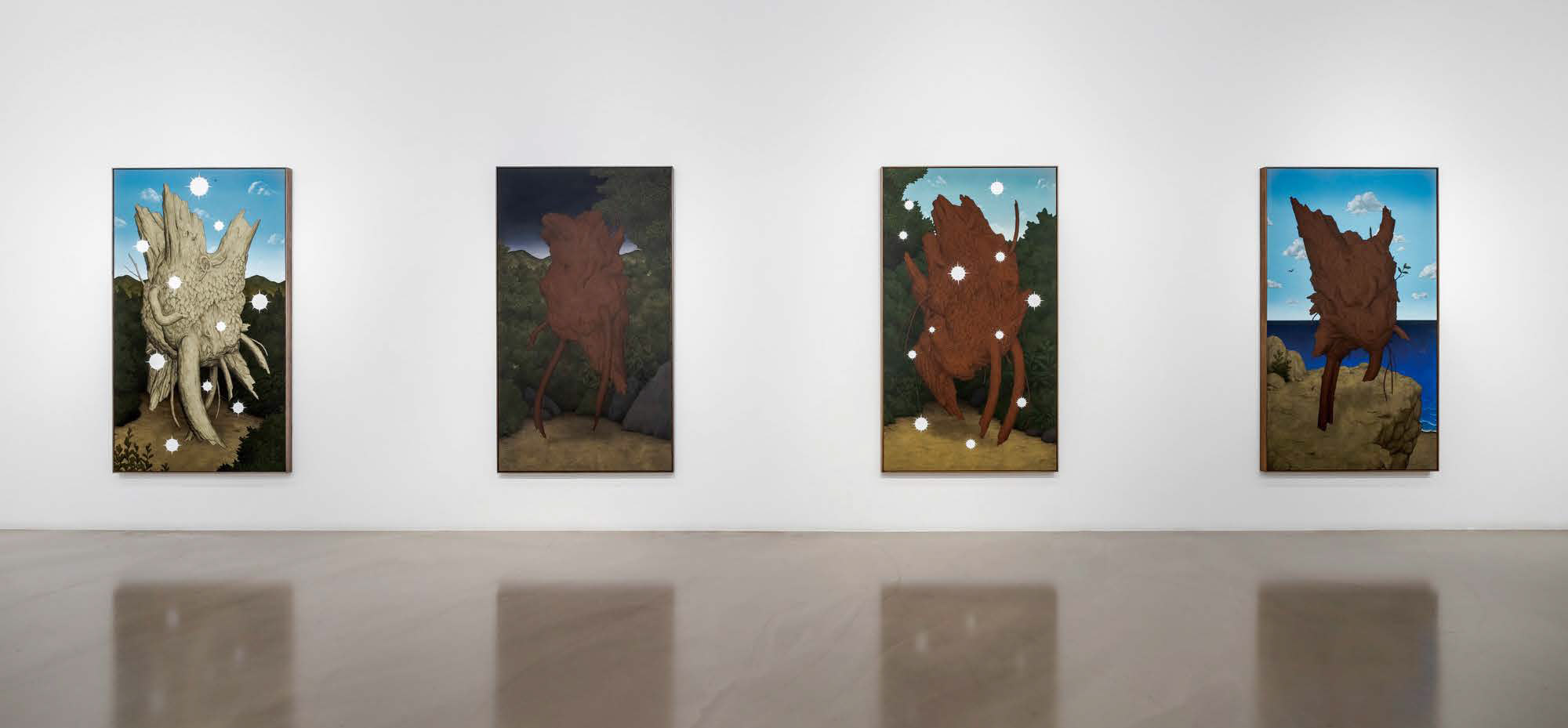
According to the artist, he suffered an accident in a training session that he received upon joining the military after he finished his freshman year of college. The incident left his right ankle bone broken. At the time, the surgery, which involved setting the shattered bones back in place with prostheses and screws, came as an unprecedented shock and roused Lee to the fact of other realities/existences. The injured body lying petrified with fear on the horrifyingly chill-steeped stainless steel of the operating table, the mechanical tools and screws inserted into that body in order to piece the shattered bones together, and the sense of incongruity coming from the prostheses which functioned in the place of the original bones for months on end—all of these elements provoked the germination of a grotesque yet beautifully surreal narrative in Lee’s paintings, one that emerges through the arbitrary juxtaposition or conjunction of two disparate realities/existences.
*This publication was supported by Ministry of Culture, Sports and Tourism Republic of Korea and Korea Arts Management Service
1 Artist notes, 2024
© (주)월간미술, 무단전재 및 재배포 금지


